Industrial cold storage is a specialized refrigeration system designed to maintain stable temperature and humidity within an enclosed space for the long-term preservation of goods, raw materials, and finished products. Industrial cold storage plays an important role in the food processing, seafood, agricultural, pharmaceutical, logistics, and manufacturing industries.
Industrial cold storage is a specialized refrigeration system designed to maintain stable temperature and humidity within an enclosed space for the long-term preservation of goods, raw materials, and finished products. Industrial cold storage plays an important role in the food processing, seafood, agricultural, pharmaceutical, logistics, and manufacturing industries.
Unlike conventional freezers or refrigeration equipment, an industrial cold storage facility provides a much larger storage capacity, more precise temperature control, and a customized design based on the characteristics of the stored products and actual operating conditions.
In this article, Công Nghiệp BA provides a detailed overview of the structure, operating principle, common types, and major applications of industrial cold storage systems in modern production and preservation operations.
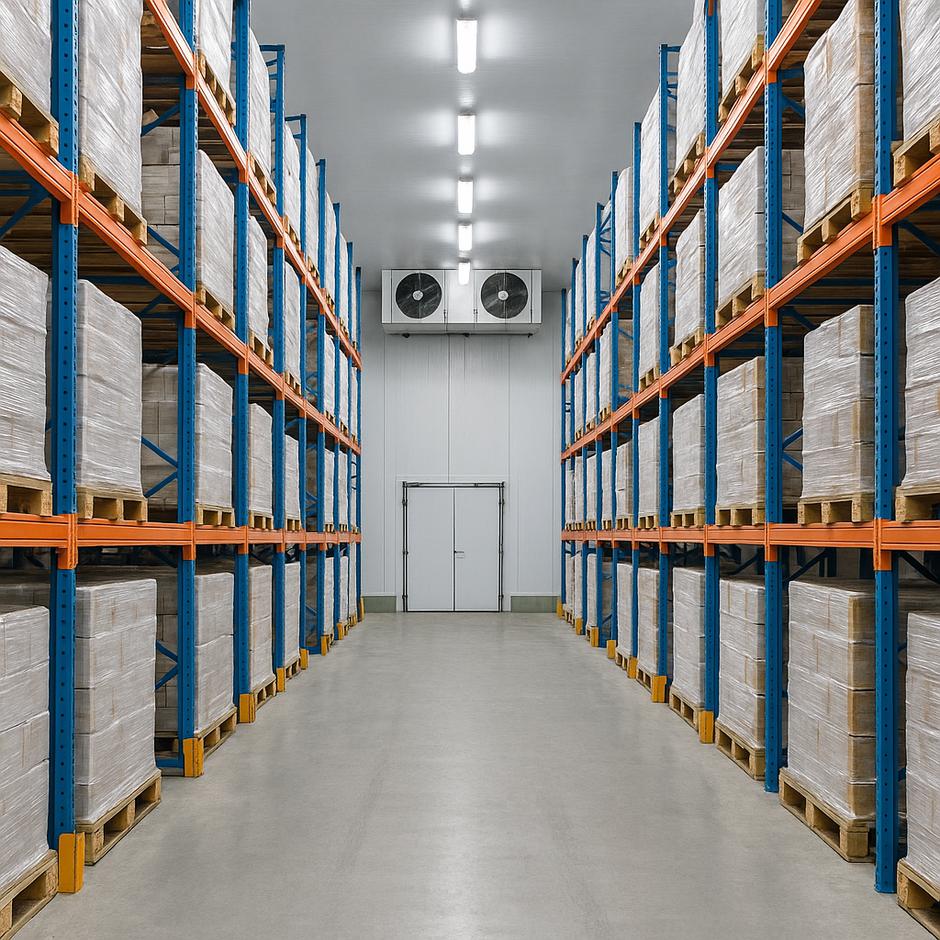
Industrial cold storage is an insulated storage space equipped with a refrigeration system to maintain the temperature required for a specific type of product.
Depending on the intended application, the storage temperature can be maintained at chilled, frozen, or deep-freezing levels. The appropriate temperature depends on the characteristics of the products, required storage duration, and technical requirements of each industry.
A complete industrial cold storage system typically consists of several interconnected components, including a refrigeration compressor, condenser, evaporator, expansion valve, refrigerant piping, control panel, and thermal insulation system.
By maintaining stable storage conditions, industrial cold storage helps slow product deterioration, inhibit microbial growth, and extend product shelf life.
For efficient operation, an industrial cold storage system must be properly designed with an integrated combination of structural components, insulation materials, and refrigeration equipment.
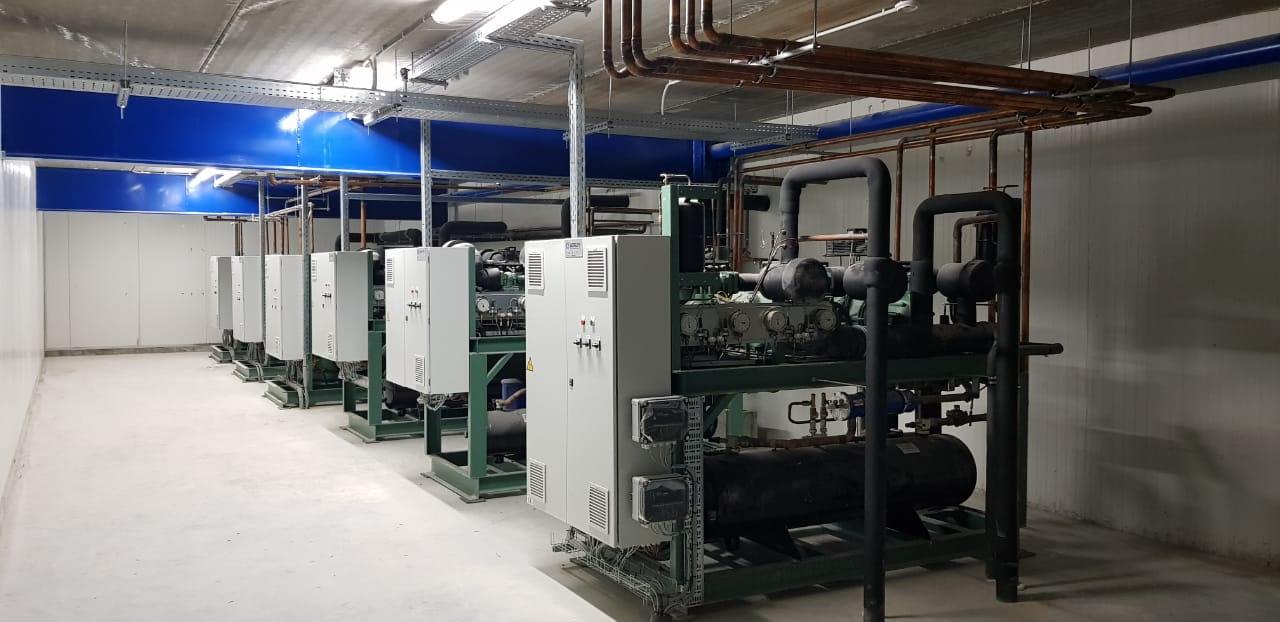
The cold room enclosure forms the storage space and minimizes heat transfer between the interior and the surrounding environment.
Insulated sandwich panels are commonly used for the walls, ceiling, and doors of an industrial cold storage facility. These insulation materials play a critical role in reducing heat gain, allowing the refrigeration system to operate more efficiently and maintain stable storage temperatures.
The required panel thickness should be determined based on the target storage temperature, cold room dimensions, ambient conditions, and the type of products being stored.
The refrigeration compressor is one of the most important components of an industrial cold storage system.
Its primary function is to draw low-pressure refrigerant vapor from the evaporator and compress it to a higher pressure before sending it to the condenser.
For large-scale industrial cold storage systems, different compressor technologies can be selected depending on the required refrigeration capacity and operating conditions.
Selecting the appropriate compressor directly affects refrigeration performance, cooling capacity, energy consumption, and the overall operating efficiency of the system.
The condenser is responsible for rejecting the heat absorbed by the refrigerant to the surrounding environment.
After compression, the refrigerant enters the condenser at high pressure and high temperature. Heat is released to the ambient environment, causing the refrigerant to condense from vapor into a high-pressure liquid.
For large-capacity industrial cold storage systems, the condenser should be selected based on refrigeration capacity, ambient temperature, and the required heat-rejection method.
The evaporator is installed inside the cold storage room and is responsible for absorbing heat from the storage space.
Air inside the industrial cold storage is circulated through the evaporator by fans. Heat from the storage space is absorbed by the refrigerant and transferred out of the cold room through the refrigeration cycle.
The evaporator capacity and design should be appropriate for the required storage temperature, room volume, product type, and air circulation requirements.
The expansion valve regulates the flow of refrigerant entering the evaporator while reducing the refrigerant pressure before the evaporation process.
This component has a significant impact on refrigerant flow control and the overall efficiency of the refrigeration system.
Depending on the system design, an industrial cold storage system may use a thermostatic expansion valve (TXV) or an electronic expansion valve (EEV).
The refrigerant piping system connects the major components of the refrigeration cycle, including the compressor, condenser, expansion valve, and evaporator.
The piping system of an industrial cold storage system must be properly sized according to the refrigerant type, refrigeration capacity, piping length, pressure drop, and actual operating conditions.
Incorrect piping design can increase pressure losses and negatively affect the efficiency and performance of the refrigeration system.
The control system monitors and maintains the temperature inside the cold storage room according to the preset requirements.
Temperature sensors continuously measure the actual storage conditions and send signals to the control system. When the temperature exceeds the specified range, the system can automatically adjust the operation of the refrigeration equipment.
Modern industrial cold storage systems can also integrate temperature alarms, remote monitoring, data logging, and automated control functions.
The operating principle of industrial cold storage is based on the refrigeration cycle. The system uses a refrigerant to absorb heat from inside the cold storage room and reject that heat to the external environment.
The refrigeration process can be divided into several main stages.
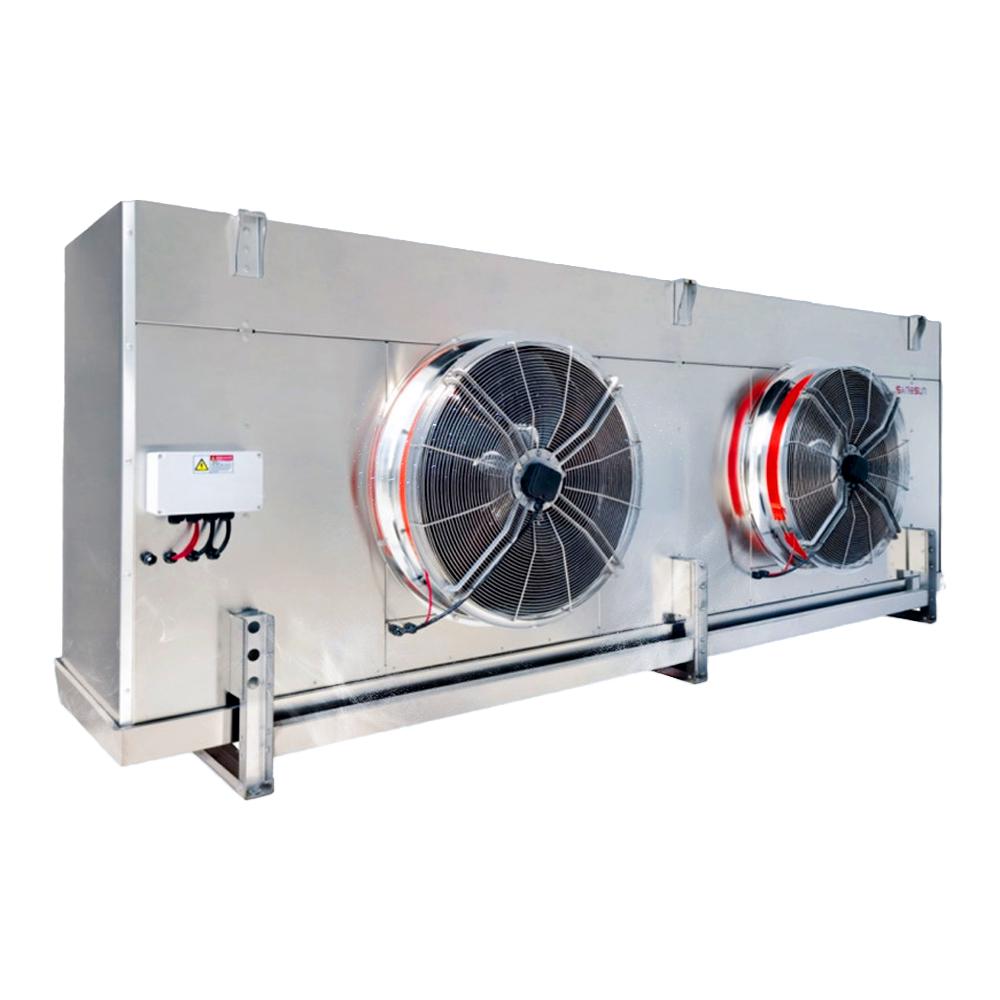
Low-pressure refrigerant vapor is drawn into the compressor.
The compressor increases the refrigerant pressure and temperature through the compression process before sending it to the condenser.
The high-temperature refrigerant flows into the condenser.
At this stage, heat is rejected to the surrounding environment. The refrigerant gradually condenses into a high-pressure liquid.
The high-pressure liquid refrigerant then passes through the expansion valve.
The expansion valve reduces the refrigerant pressure while controlling the amount of refrigerant entering the evaporator.
After passing through the expansion valve, the refrigerant enters the evaporator at low pressure and low temperature.
The refrigerant absorbs heat from the air inside the industrial cold storage and evaporates.
The air inside the cold room is cooled through heat exchange with the evaporator coil.
After evaporation, the refrigerant returns to the compressor and begins a new refrigeration cycle.
This process continues continuously to maintain a stable temperature inside the industrial cold storage system.
Depending on the required temperature and intended application, industrial cold storage systems can be divided into several main categories.
Chilled industrial cold storage is commonly used for vegetables, fruits, dairy products, fresh food, and other products that require low-temperature storage without freezing.
The storage temperature is set according to the specific requirements of each product.
Frozen industrial cold storage is used for meat, seafood, processed food, and other products that need to remain frozen during storage.
Frozen storage systems generally require a higher refrigeration capacity than chilled storage and must use suitable thermal insulation materials.
Blast freezing rooms are a type of industrial cold storage designed to rapidly reduce product temperature within a short period.
These systems are commonly used in seafood processing, food processing, and production lines that require rapid freezing.
Pharmaceutical products and certain medical products require strict temperature control.
Therefore, pharmaceutical industrial cold storage systems must provide accurate temperature regulation, temperature deviation alarms, and stable operating conditions throughout the storage process.
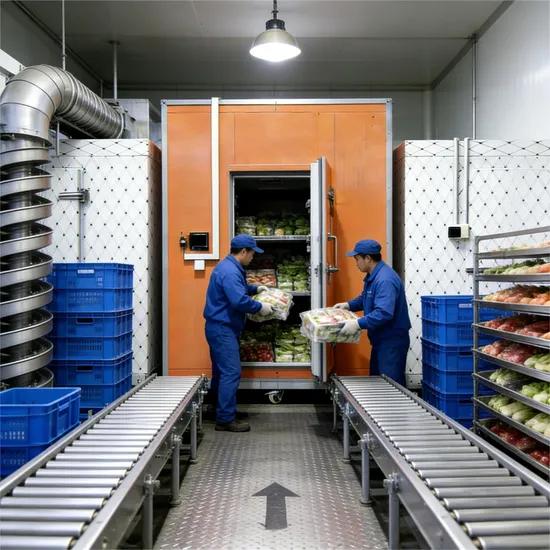
Industrial cold storage is widely used across numerous production, processing, and commercial industries.
The food industry uses industrial cold storage to preserve meat, fish, seafood, vegetables, fruits, dairy products, and processed food.
Maintaining an appropriate temperature helps slow down product deterioration and preserve product quality over an extended period.
The seafood industry is one of the major sectors using large-scale industrial cold storage systems.
Seafood processing plants often require frozen storage, blast freezing systems, and cold storage rooms to maintain product quality before transportation and export.
Fresh vegetables and fruits often require controlled temperature conditions after harvesting to reduce respiration rates and minimize product losses.
Industrial cold storage allows businesses to extend storage time and improve flexibility in the distribution of agricultural products.
Certain medicines, vaccines, pharmaceutical ingredients, and biological products require strictly controlled temperature conditions.
Refrigeration systems must provide stable operation and continuous temperature monitoring to ensure appropriate storage conditions.
Industrial cold storage plays a critical role in the cold chain.
From manufacturing facilities to distribution warehouses, transportation, and final distribution points, appropriate temperature control is essential to protect product quality throughout the supply chain.
To ensure efficient operation, businesses need to clearly define their requirements before selecting equipment and designing an industrial cold storage system.
Different products have different temperature requirements.
Accurately defining the required storage temperature is essential for selecting the appropriate refrigeration capacity, insulation panels, evaporators, and other equipment for the industrial cold storage.
The refrigeration capacity required for an industrial cold storage system depends on several factors, including cold room volume, ambient temperature, product entering temperature, door-opening frequency, product load, and operating conditions.
If the refrigeration capacity is too low, the system may struggle to reach the required temperature. On the other hand, excessive refrigeration capacity can increase initial investment and energy consumption.
The thermal insulation performance of an industrial cold storage facility directly affects energy consumption.
A well-insulated cold room minimizes heat gain from the external environment and reduces the operating time of the refrigeration equipment.
High-quality insulation is therefore an important factor in maintaining stable temperatures and improving the energy efficiency of the entire system.
The compressor, condenser, evaporator, expansion valve, piping system, and control equipment should be properly matched.
Even high-quality refrigeration equipment may operate inefficiently if the components are incorrectly selected or poorly matched within the industrial cold storage system.
Investing in an industrial cold storage system provides numerous benefits for businesses.
First, it extends product shelf life. Maintaining appropriate temperatures helps slow microbial activity and reduces product deterioration.
Second, it reduces product losses. This is particularly important for food, agricultural products, seafood, and other temperature-sensitive goods.
Third, it improves inventory management. Businesses can store products for longer periods instead of depending entirely on immediate consumption or distribution after production.
Fourth, it supports the cold chain. An industrial cold storage system helps maintain appropriate preservation conditions from production and processing through storage and distribution.
Fifth, it improves operational flexibility. Businesses can better manage production schedules, inventory levels, and distribution plans when adequate cold storage capacity is available.
Regular maintenance is essential for maintaining the efficiency and service life of an industrial cold storage system.
Businesses should periodically inspect the compressor, condenser, evaporator, fans, expansion valve, refrigerant piping, electrical components, and control system.
The heat exchange surfaces of the evaporator should also be cleaned regularly, while excessive frost formation should be checked and addressed.
The condenser should be inspected and cleaned to ensure effective heat rejection and maintain proper refrigeration performance.
If the industrial cold storage fails to maintain the required temperature, the compressor operates continuously, or electricity consumption increases abnormally, the system should be inspected to identify the underlying cause.
Regular preventive maintenance not only reduces the risk of unexpected breakdowns but also helps optimize operating costs and extend equipment service life.
An efficient industrial cold storage system requires accurate engineering calculations, appropriate thermal insulation, and properly matched refrigeration equipment.
Công Nghiệp BA provides refrigeration equipment and solutions for industrial cold storage, industrial refrigeration systems, factories, storage facilities, food processing plants, and other applications requiring reliable temperature control.
Businesses can explore industrial refrigeration equipment and related products at:
Industrial Refrigeration Products – Công Nghiệp BA
Industrial cold storage is an essential solution for businesses that need to preserve products under controlled temperature conditions.
A complete industrial cold storage system is not simply an insulated storage room. It requires the coordinated operation of the compressor, condenser, expansion valve, evaporator, refrigerant piping, insulation system, and control equipment.
Selecting the appropriate equipment, accurately calculating the required refrigeration capacity, and implementing regular preventive maintenance can help the system operate reliably, improve energy efficiency, and extend equipment service life.
For businesses planning to install, expand, or upgrade an industrial cold storage system, selecting a professional supplier with expertise in industrial refrigeration is an important step toward achieving long-term operating efficiency and reliable temperature control.

Cám ơn bạn đã gửi đánh giá cho chúng tôi! Đánh giá của bạn sẻ giúp chúng tôi cải thiện chất lượng dịch vụ hơn nữa.


OUR PARTNERS






ĐÁNH GIÁ SẢN PHẨM